
The DDR4 That Wouldn't Retire: Inside Meta's CXL Memory Board — and Why It Redraws the Aftermarket
By DRAM Resource Editorial Staff
For years the secondary-memory conversation has run into the same wall: retired server DRAM is stranded by the hardware it shipped in. A DDR4 RDIMM pulled from a decommissioned server can only go back into another DDR4 server, and as the primary fleet moves to DDR5-only platforms, that pool of buyers shrinks. The module still works perfectly. It just has nowhere native to go.
Meta has now engineered its way around that wall — and in doing so has done something more interesting than save money on RAM. It has demonstrated, at hyperscale and in production, that retired DDR4 can be given a second job inside modern servers that were never built to accept it. The mechanism is worth understanding in detail, because the economics it unlocks do not stay inside Meta's data centers. They reset the residual-value math for anyone who owns, buys, or disposes of server memory.
The Constraint: DDR5-Only Servers Sitting Next to Piles of Good DDR4
New server platforms are standardizing on DDR5. Their memory controllers do not speak DDR4, so the direct-attach path is closed — you cannot simply slot an old RDIMM into a new board. At the same time, new DRAM has grown expensive and slow to source, a cost the industry has taken to calling the "RAM tax." Meta was therefore holding two things at once: warehouses of functional DDR4 coming off retirement, and a bill for new memory it did not want to pay.
The obvious answer — buy new, scrap old — is exactly the reflex the secondary market exists to correct. Meta chose the harder, more revealing path: keep the old memory in service.
The Explainer: What CXL Does, and What Meta Built On Top of It
CXL — Compute Express Link — is an open interconnect that lets a processor reach memory across the PCIe electrical bus while still treating it as ordinary, byte-addressable RAM rather than as storage. A "Type-3" CXL device is, in plain terms, a memory expander: a card that presents additional capacity to the host over PCIe, which the operating system then sees as a slower tier of the same memory pool.
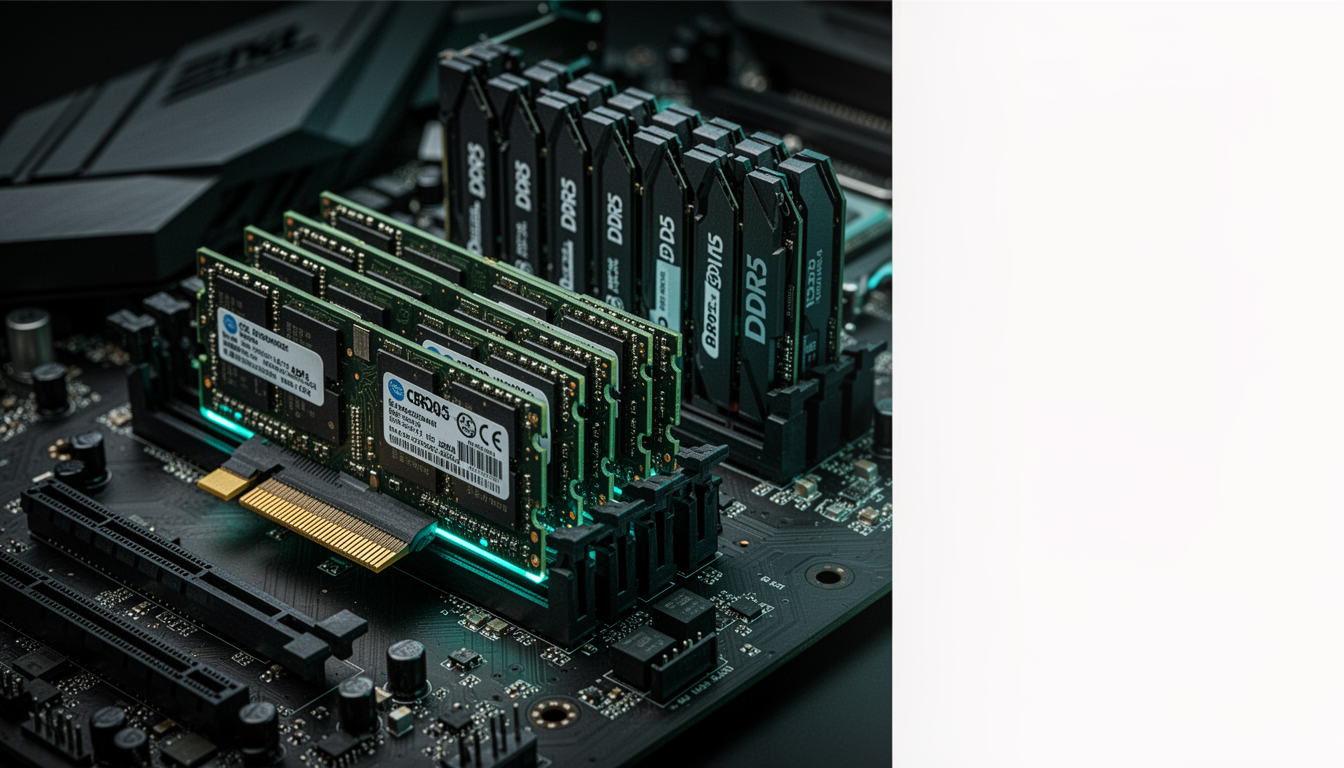
Meta's contribution is a custom expander ASIC, named Vistara, sitting on a plug-in board. The board is a CXL 2.0 Type-3 memory expander that connects to the host over a PCIe 5.0 x16 slot — the same kind of slot a network card or accelerator would use. On the far side of that ASIC sit standard DDR4 RDIMMs. The controller is decoupled from the DIMMs, which is the pivotal design choice: because the Vistara ASIC — not the host — talks to the DDR4 directly, the old memory no longer needs a DDR4-native server. It needs only a PCIe slot and this board.
Each ASIC drives two independent 72-bit DDR4 channels at up to 3200 MT/s. In production, Meta populates the board with 32GB DIMMs — roughly 128GB per ASIC, two ASICs per board, for about 256GB of CXL-attached DDR4 capacity. A representative node then pairs 768GB of local DDR5-6400 with that 256GB of bridged DDR4-2400, reaching a full terabyte of memory per server without a single new DDR4-native machine existing to hold it.
Why the Speed Penalty Doesn't Sink the Idea
CXL-attached memory is not as fast as memory soldered next to the CPU. Reaching DDR4 across the PCIe bus costs roughly ten times less bandwidth and about 60% more latency than local DDR5. If every workload had to run out of that tier, the idea would collapse.
It doesn't, because of the software layer. A page-placement system — Meta calls it Transparent Page Placement — continuously sorts memory pages by temperature: hot, frequently-touched pages are promoted to fast local DDR5, while cold pages are demoted to the CXL-attached DDR4 pool. Latency-sensitive workloads can have the expanded tier disabled entirely. The old DDR4 ends up holding exactly the data that does not care how fast it is reached, which turns a performance liability into free capacity.
The production results make the case. Using the expanded tier, Meta reports cutting the number of servers needed for disaggregated ML inference by up to 25%, and shortening average response time for distributed caches by about 29%. Those are not lab numbers; they are fleet outcomes, delivered in part by memory that would otherwise have been scrapped. The same architecture is heading toward larger shared pools — a parallel line of CXL switching work shown alongside Meta's at this summer's industry sessions demonstrated stable memory fabrics spanning as many as 64 nodes — which only deepens the appetite for capacity that reuse can feed.
The Aftermarket Read: Residual Value Just Got a Hardware Floor
Here is why this matters far outside Meta. The single biggest drag on used-DDR4 pricing has been the shrinking population of machines that can use it. Meta has just shown that the ceiling on that population is not fixed — that with the right board, DDR4's addressable home extends into the DDR5 generation and beyond. When the largest memory buyers treat their retired DDR4 as deployable inventory rather than scrap, they are making a residual-value judgment in public, at enormous scale. The signal is unambiguous: this silicon is worth keeping.
For the corporate buyer, IT asset manager, and ITAD program, three consequences follow.
First, disposition is a pricing decision, not just a logistics one. Retired memory clears at stronger levels precisely when new supply is tight — which is now — and the calendar around a refresh determines how much of that strength you capture. Dumping a fleet's memory into a recycling stream during a shortage forfeits value that the secondary market is actively bidding up.
Second, provenance and grading become the line between "scrap" and "supply." The reason Meta can trust redeployed modules is that their condition and history are known. Memory that arrives with verified provenance and honest grading commands the reuse premium; memory that doesn't gets priced as salvage. The discipline is the difference.
Third, the reuse window for DDR4 is longer than the DDR5 transition implied. The direct-attach path may be closing, but the CXL path is opening, and it keeps demand for good DDR4 alive well past the point where conventional wisdom wrote it off. That extends the horizon over which retired modules retain meaningful value — and rewards holders who understand where the second-life demand is forming rather than assuming it has evaporated.
Two Questions the Announcement Leaves Open
The first is uncomfortable for the secondary market: if the residual value was always sitting there, why did it take a hyperscaler's silicon team — not the aftermarket — to engineer the bridge that unlocks it?
The answer is structural, and it is worth sitting with. The independent aftermarket sells modules, not silicon. It is fragmented across thousands of brokers, refurbishers, and buyers, none of whom own both ends of the problem. Meta does. It is simultaneously the largest disposer of its own retired DDR4 and the buyer of the new servers that memory could feed — a closed loop with the R&D budget and the millions-of-servers scale needed to justify designing a custom CXL ASIC and the kernel software to drive it. No fragmented market builds a bridge chip; only a vertically integrated operator that stands on both banks of the river does. The lesson is not that the aftermarket missed the opportunity — it is that the aftermarket's job was never to build the bridge. Its job is to price and supply the memory the bridge makes valuable, and that job just got bigger.
The second question is the one that should shape how buyers read the next two years: if Meta did this, what about Amazon, Microsoft, and Google? The broader move toward CXL-attached memory is not Meta's alone — Microsoft has publicly pursued CXL memory pooling and has begun offering CXL-equipped cloud capacity, while Google has openly questioned whether the pooling economics justify the complexity. But note the distinction. Most of that work is about pooling underused memory to cut DRAM spend; Meta's twist is narrower and more consequential for the secondary market — it points CXL specifically at retired DDR4, turning a disposal liability into deployable capacity. Every hyperscaler is sitting on the same mountain of decommissioning DDR4 and paying the same RAM tax. The incentive that moved Meta applies to all of them, and proven patterns propagate fast at this tier. If even one more follows Meta's reuse-specific path rather than the pooling path, the demand floor under graded secondary DDR4 rises again — this time set by the largest buyers on earth deciding, in public, that old memory is worth keeping in service.
Meta built a specialized board most organizations will never replicate. But the conclusion underneath it is portable and plain: retired DDR4 still has a job, the market for it is wider than it looked a year ago, and in a constrained supply environment, that job is worth real money. Pricing your used memory as waste is now, demonstrably, the wrong default.
References
- https://www.storagenewsletter.com/2026/07/02/meta-uses-cxl-for-memory-expansion-to-replace-ddr4/
- https://www.tomshardware.com/pc-components/dram/meta-fights-soaring-hardware-costs-by-reusing-old-ddr4-server-memory-in-new-ddr5-only-servers-custom-cxl-2-0-chip-marries-legacy-ddr4-2400-with-cutting-edge-ddr5-6400
- https://www.blocksandfiles.com/architecture/2026/06/26/panmnesia-boosts-cxl-scale-with-fabric-switching-meta-repurposes-old-dram-with-cxl/5263151
Questions or comments? We'd love to hear from you — reach the editorial team at info@dramresource.com.