
The Buyer's Playbook for a Locked Market: Phased Sourcing, Hybrid SKUs, and the Secondary Floor
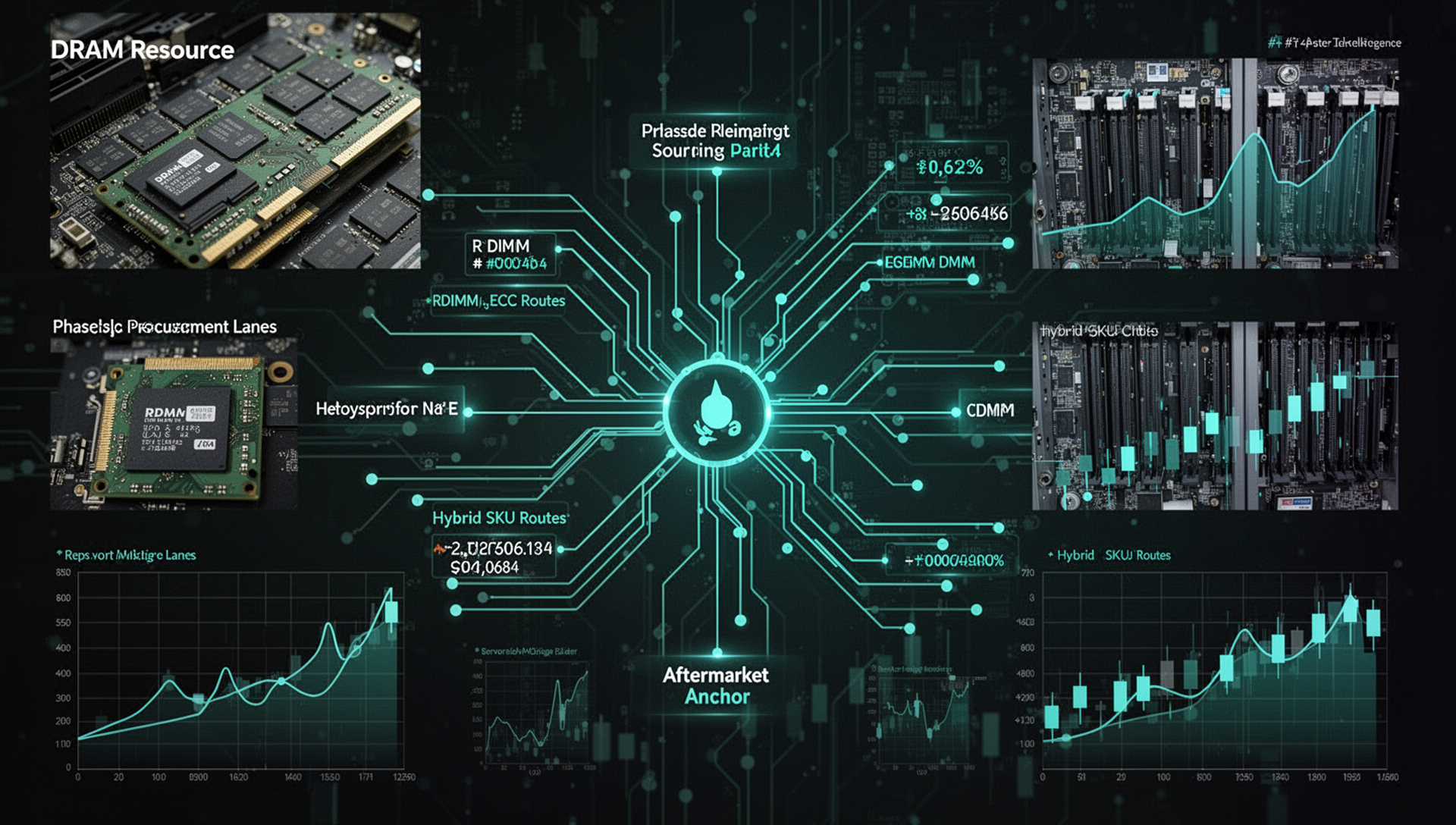
By DRAM Resource Editorial Staff
In 2026, corporate memory procurement has entered a constraint regime that punishes passive buyers. DDR5 and high-density RDIMM allocations have tightened across Tier 1 OEM channels, and teams relying on annual refresh cycles with single-source contracts are now facing 16–22-week lead times and spot prices running 28–35% above Q1 2025 benchmarks. The market has locked, and waiting is not a strategy.
The procurement operations outperforming this cycle share a structural approach: they use the secondary market not as a fallback, but as the anchor of the entire sourcing framework.
The Allocation Lock Problem
New-production memory availability in 2026 is subject to cascading constraint: limited 1β node wafer capacity, HBM3e channel prioritization at leading fabricators, and AI accelerator demand absorbing the premium enterprise DIMM supply that would otherwise clear into server refresh channels. The result is a two-tier market where spot new-production inventory trades at significant premiums and allocation windows are controlled by OEM partner tiers that most ITAD operators and mid-market buyers do not hold.
Waiting for allocation to normalize is a bet that memory fabricators will redirect capacity away from AI infrastructure — a structural shift that no current demand signal supports. The DRAM Pulse Report tracks these allocation signals on a weekly basis; the directional read for H2 2026 remains constrained.
Phased Sourcing: Avoid Bulk Commitments Under Lock
The logic of phased procurement is straightforward: instead of committing full refresh volume in a single purchase order at peak scarcity, buyers sequence buys in 30–45-day tranches aligned with secondary-market liquidity windows. This approach reduces exposure to single-point pricing spikes, preserves cash flow against a market where Q3 pricing surveys across major secondary marketplaces show 8–14% intra-quarter volatility, and creates optionality — when a secondary tranche clears below the OEM allocation quote, the buyer captures the spread.
The DRAM Market Pulse tool provides the real-time aftermarket pricing reference that makes tranche timing tractable for procurement teams operating across multiple SKU families.
Hybrid SKU Architecture: Refurb-Plus-New
A uniform new-production-only procurement policy is a liability in a locked market. The hybrid SKU approach matches memory grade to workload criticality:
- New-production DDR5 RDIMM for net-new AI inference and high-frequency transaction systems where warranty terms and density requirements are non-negotiable
- Grade-A refurbished DDR4 ECC RDIMM for server refresh on VMware, backup, and archive tiers — where certified aftermarket modules deliver equivalent performance at 35–55% below OEM list
- Tested pulls (Grade B) for dev/test, staging, and short-horizon lab environments where cost compression is the dominant variable
Proprietary pricing surveys across the five primary secondary marketplaces tracked by DRAM Resource confirm that Grade-A certified DDR4 RDIMM 64GB modules are currently clearing at $38–$47 per unit, against new-production equivalents quoted at $72–$84 under constrained allocation. The arbitrage is structural, not cyclical.
The Secondary Floor as Negotiation Anchor
The most underused lever in enterprise memory procurement is using live secondary-market clearing prices as the opening floor in OEM allocation negotiations. When procurement teams arrive at Tier 1 conversations with documented aftermarket comps — specific SKU, specific grade, specific marketplace clearing price — the OEM allocation premium compresses, because the buyer has credibly demonstrated a credible alternative.
The secondary floor discipline also resets internal approval thresholds. Finance teams benchmarking against last-cycle OEM pricing are approving against an artificially elevated baseline. Secondary-market comps tracked through the Industry Analysis library provide the data foundation for realistic budget modeling in a locked market.
Building Your 2026 Playbook
- Anchor to secondary clearing prices — track weekly via the Pulse tool, not quarterly via OEM quotes
- Phase buys in 30–45-day tranches; resist the urgency that drives bulk commitments at peak scarcity
- Tier your SKU policy to workload criticality; certified refurb on non-critical tiers frees capital for new-production where it genuinely matters
- Use aftermarket data as negotiation ammunition — document comps, present them, reset your OEM relationships accordingly
Buyers who navigate locked markets effectively are not the ones waiting for conditions to improve. They are the ones building flexible, data-anchored sourcing structures that extract value from precisely this kind of volatility. For ongoing supply-side signals and allocation intelligence, the DRAM Industry News feed tracks the indicators that determine when allocation windows open.
References
- Hardware Procurement Strategy: When to Buy Servers and Components Before Prices Surge — https://www.softwareseni.com/hardware-procurement-strategy-when-to-buy-servers-and-components-before-prices-surge/
- 2026 Memory Shortage: Strategic Insights — https://blog.shi.com/strategic-insights/2026-memory-shortage/
- Tracking Memory Price Increases Across the Last Several Quarters — https://sourceability.com/post/tracking-memory-price-increases-across-the-last-several-quarters
Questions or comments? We'd love to hear from you — reach the editorial team at info@dramresource.com.