
The 4.9% Deficit: How the Widest DRAM Supply Gap Since 2011 Routes Demand to the Aftermarket
By DRAM Resource Editorial Staff
A Structural Imbalance, Not a Blip
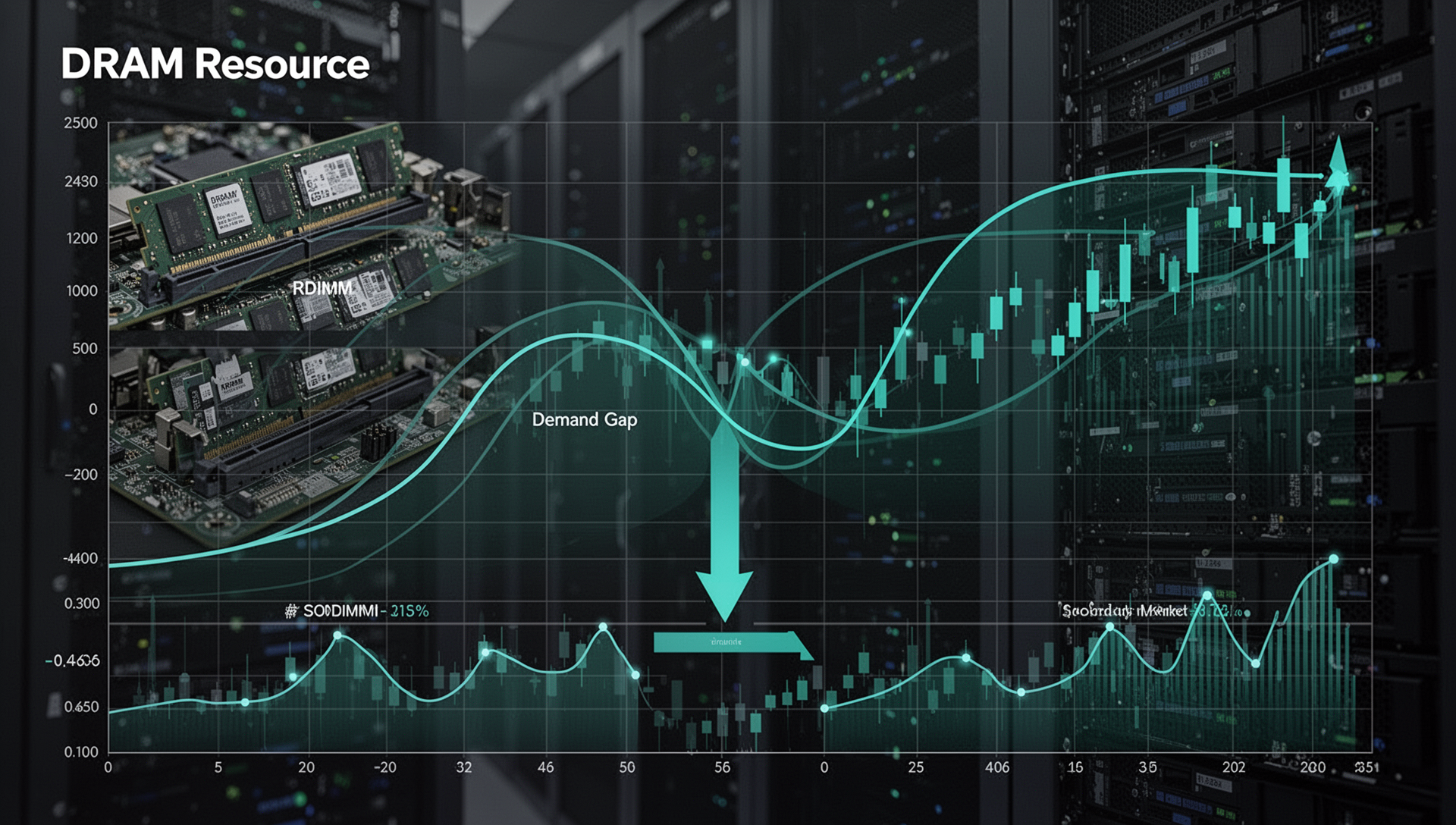
The DRAM market is running a 4.9% supply deficit relative to demand — the widest gap recorded since 2011. Unlike cyclical corrections, this shortfall is structural: HBM conversion has permanently redirected Samsung, SK Hynix, and Micron wafer capacity away from commodity DDR4/DDR5, while hyperscaler AI infrastructure buildout has compounded end-demand at a pace the supply chain cannot absorb in the near term. New greenfield capacity — the fabs announced in 2023 and 2024 — will not reach volume production before 2027 at the earliest. Until then, buyers with deferred refresh cycles and unplanned server expansions are absorbing the imbalance through one available channel: the secondary market.
Contract Prices Signal No Near-Term Relief
Q1 2026 contract negotiations set a tone that has persisted into Q2: DDR5 server module pricing climbed 6–9% quarter-over-quarter, with DDR4 ECC not far behind at 4–6%. NAND followed a parallel trajectory, though memory buyers rarely conflate the two dynamics. What distinguishes this cycle from prior squeeze events is the absence of inventory pre-loading — distributors and OEM procurement teams, burned by 2022 corrections, kept lean. The result: spot prices are running 12–18% above contract in some density tiers, a spread that makes secondary-channel sourcing economically rational rather than a last resort.
Monitoring these signals in real time is critical. The DRAM Market Pulse tool tracks contract and spot spreads across primary marketplaces weekly.
Demand That Cannot Wait for New Fabs
The 2027 supply ramp is not speculation — it is a sequenced capital commitment visible in published CapEx disclosures. What the numbers do not resolve is the demand curve between now and then. AI server deployments are being pulled forward; enterprise server refresh cycles delayed by 2022–2024 budget conservatism are now operationally urgent; and sovereign infrastructure programs in Southeast Asia and the Middle East are adding absorptive demand that 2021-era models did not anticipate. The compound result is a demand curve that outpaces supply growth through at least mid-2027.
The DRAM Pulse Report documents quarterly density-tier breakdowns showing where the undersupply is most acute: 64GB and 128GB registered DIMMs for dual-socket server configurations are the tightest segments, followed by 32GB DDR5-4800 for edge compute.
The Secondary Market as a Structural Pressure Valve
ITAD operators, memory recyclers, and secondary-market resellers are playing a role that goes beyond opportunistic arbitrage. With new-supply allocation windows stretching to 16–22 weeks on high-demand SKUs, organizations that cannot absorb that lead time are turning to tested, grade-A secondary stock. Pull-forward procurement from decommissioned enterprise fleets — particularly the 2018–2020 server generations now aging out of enterprise data centers — is feeding a supply stream that partially offsets the OEM deficit.
For corporate buyers and ITAD operators, the pricing environment rewards agility. Secondary pricing surveys across the five primary spot marketplaces show compression of the grade-A premium to under 8% above broker ask for top-tier DDR5 SKUs — historically narrow, reflecting institutional acceptance of secondary-sourced memory at scale.
Track active pricing movements and supply-tier analysis in Industry Analysis and the latest developments at Industry News.
Key Takeaways for Procurement and ITAD Operators
- The 4.9% DRAM supply deficit is the widest since 2011 and will persist until 2027+ capacity comes online.
- DDR5 server module contracts climbed 6–9% QoQ in Q1 2026; spot premiums of 12–18% over contract are driving secondary-channel economics.
- Secondary market absorption of enterprise DRAM is operating at institutional scale, not fringe arbitrage.
- Grade-A secondary premiums have compressed to under 8% on key DDR5 server SKUs, reflecting buyer acceptance and market maturity.
- Procurement teams facing 16–22 week new-supply lead times should build secondary-channel sourcing into standard RFQ processes now.
References
- DRAM and NAND Contract Prices to Climb Again in Q2 — https://www.tomshardware.com/pc-components/dram/dram-and-nand-contract-prices-to-climb-again-in-q2
- The Memory Shortage Is Set to Grow Through 2026 — https://sourceability.com/post/the-memory-shortage-is-set-to-grow-through-2026
- Global Memory Shortage Crisis: Market Analysis and the Potential Impact on Smartphone and PC Markets in 2026 — https://www.idc.com/resource-center/blog/global-memory-shortage-crisis-market-analysis-and-the-potential-impact-on-the-smartphone-and-pc-markets-in-2026/
Questions or comments? We'd love to hear from you — reach the editorial team at info@dramresource.com.