
Per-GB Reality Check: How Server RDIMM and Desktop UDIMM Economics Diverged in the Shortage
By DRAM Resource Editorial Staff
The 2025–2026 DRAM supply cycle broke a long-standing assumption: that server and desktop memory track each other closely through pricing cycles. They don't anymore. The divergence between registered (RDIMM/LRDIMM) and unbuffered (UDIMM) module economics is now structural, not cyclical — and secondary-market buyers are pricing that in.
Secondary-Market Per-GB Spread: RDIMMs vs UDIMMs
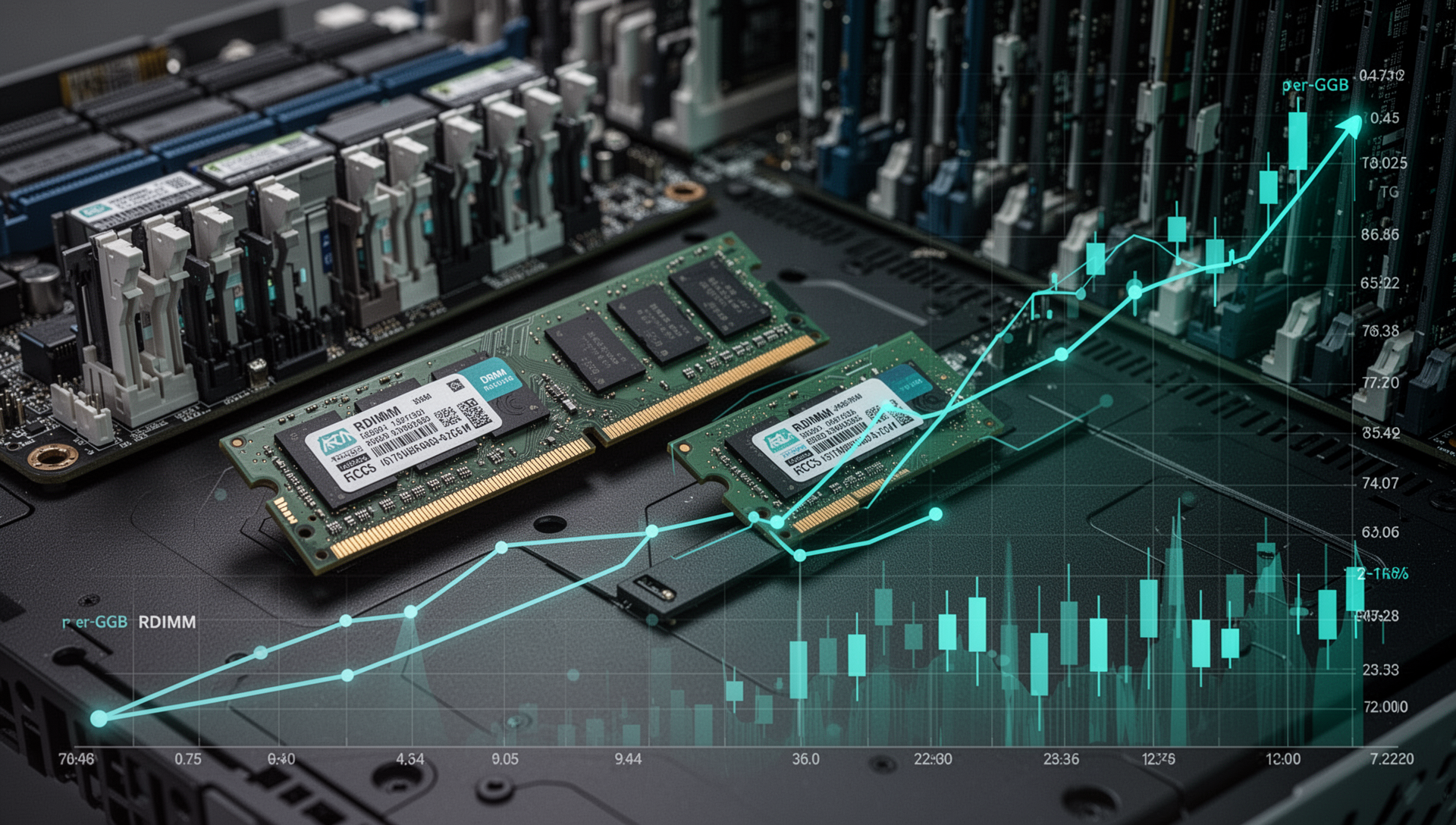
On the aftermarket, the per-GB gap between DDR4 RDIMMs and equivalent-density UDIMMs has widened substantially. 32GB DDR4-3200 RDIMMs, a workhorse for dual-socket servers, now trade at a significant premium per GB versus 32GB DDR4-3200 UDIMMs on the secondary market. The spread — which narrowed during the 2022 glut — re-opened as hyperscaler and CSP demand absorbed server-grade supply faster than desktop supply.
LRDIMMs tell a sharper story. 64GB and 128GB load-reduced modules, essential for memory-dense workloads, have seen per-GB spot prices hold at levels that would have looked extreme three years ago. Demand from AI-adjacent infrastructure — memory-hungry inference nodes, in-memory databases — has kept LRDIMM supply perpetually tight relative to what the broader DRAM market would otherwise suggest.
The DRAM Market Pulse tool tracks this spread in real time, publishing secondary-market per-GB reads across module classes alongside spot-new comparatives.
Spot-New vs. Secondary: Where the Arbitrage Sits
Spot-new DDR5 server memory appreciated sharply through Q1 2026. Contract pricing from Tier-1 suppliers to OEMs moved in tandem. Yet secondary-market RDIMM supply — pulled from decommissioned Gen 14/15 server fleets — has not kept pace with secondary demand. The result: secondary RDIMM per-GB rates have compressed toward spot-new levels in some density bands, narrowing the traditional aftermarket discount.
UDIMMs tell the opposite story. Secondary desktop modules remain priced well below spot-new DDR5, and DDR4 UDIMM surplus from consumer PC refreshes has created ample secondary supply. The aftermarket discount for desktop-grade modules is wide — often 35–50% below spot-new for common densities.
For ITAD operators and secondary buyers, the tier is clear: server-class modules command near-spot economics; desktop-class modules remain deeply discounted.
Why Suppliers Widened the Spread
The proximate cause is supplier allocation discipline. Samsung, SK Hynix, and Micron each prioritized high-ASP server DRAM output — DDR5 RDIMMs and HBM — over consumer DRAM in wafer mix decisions since mid-2024. The economics are compelling: server DRAM yields 3–5× the ASP per GB versus desktop DDR5 on current contract pricing.
That allocation shift compressed RDIMM supply into a market where demand — from hyperscalers, AI infrastructure builders, and enterprise refresh programs — remained inelastic. Desktop DRAM received less fab attention precisely because PC demand softness made it lower-priority. The resulting supply imbalance is baked into fab economics for at least two more process-node cycles.
A deeper analysis of these allocation dynamics is available in the DRAM Pulse Report and the Industry Analysis section.
Implications for Aftermarket Buyers
Corporate buyers and ITAD operators should run separate per-GB benchmarks for server and desktop modules — treating them as distinct asset classes, not variants of the same commodity. Blended per-GB metrics obscure the divergence and lead to mispriced acquisition and resale decisions.
Key operational takeaways:
- Server RDIMM/LRDIMM: Expect narrow secondary discounts to spot-new; source aggressively when decommission lots surface.
- Desktop UDIMM/SO-DIMM: Wide discounts persist; volume opportunities remain in bulk PC refresh sourcing.
- Density-specific tracking is essential: Per-GB economics vary sharply by density band (16GB vs. 32GB vs. 64GB) — module-level granularity is required for accurate valuation.
Monitor module-level pricing shifts as they develop via Industry News.
References
- DRAM Price Increases Hit DDR4 and DDR5 Server Memory in 2026 — https://corewavelabs.com/dram-price-increase-ddr4-ddr5-server-memory-2026/
- Supply Chain Brief: Memory Market Conditions in 2026 — https://www.versalogic.com/blog/supply-chain-brief-memory-market-conditions-in-2026/
- TrendForce DRAM Market Analysis, Q1 2026 — https://www.trendforce.com/presscenter/news/20260331-12995.html
Questions or comments? We'd love to hear from you — reach the editorial team at info@dramresource.com.