
Meta Turns Retired DDR4 Into a Supply Line — and Validates the Aftermarket at Hyperscale
By DRAM Resource Editorial Staff
When the world's largest infrastructure buyers start treating decommissioned memory as inventory instead of scrap, it stops being a sustainability footnote and becomes a market signal. Meta has disclosed a memory-reuse strategy that pools DDR4 modules pulled from retired servers and re-attaches them to newer fleets as expanded capacity — sidestepping the cost of buying new DRAM in the middle of a supply crunch. For anyone who has argued that the secondary memory market is a rounding error, this is the loudest counterargument yet.
The Aftermarket Signal Hiding in a Hyperscaler Announcement
Strip away the engineering and the story is simple: a company with effectively unlimited purchasing power looked at its own pile of used DDR4 and decided the smartest move was to keep using it. That is a residual-value judgment, made at the scale of one of the largest memory buyers on earth. It says the useful economic life of a DDR4 DIMM does not end when it rotates out of a primary server — it ends when nobody can find a productive place to put it.
For the corporate buyer, ITAD program, and IT asset manager, that reframes a decision that too often defaults to disposal. The memory coming off a three- or four-year-old fleet is not e-waste with a recycling value; it is capacity with a second job, and the market increasingly prices it that way.
What Meta Actually Built
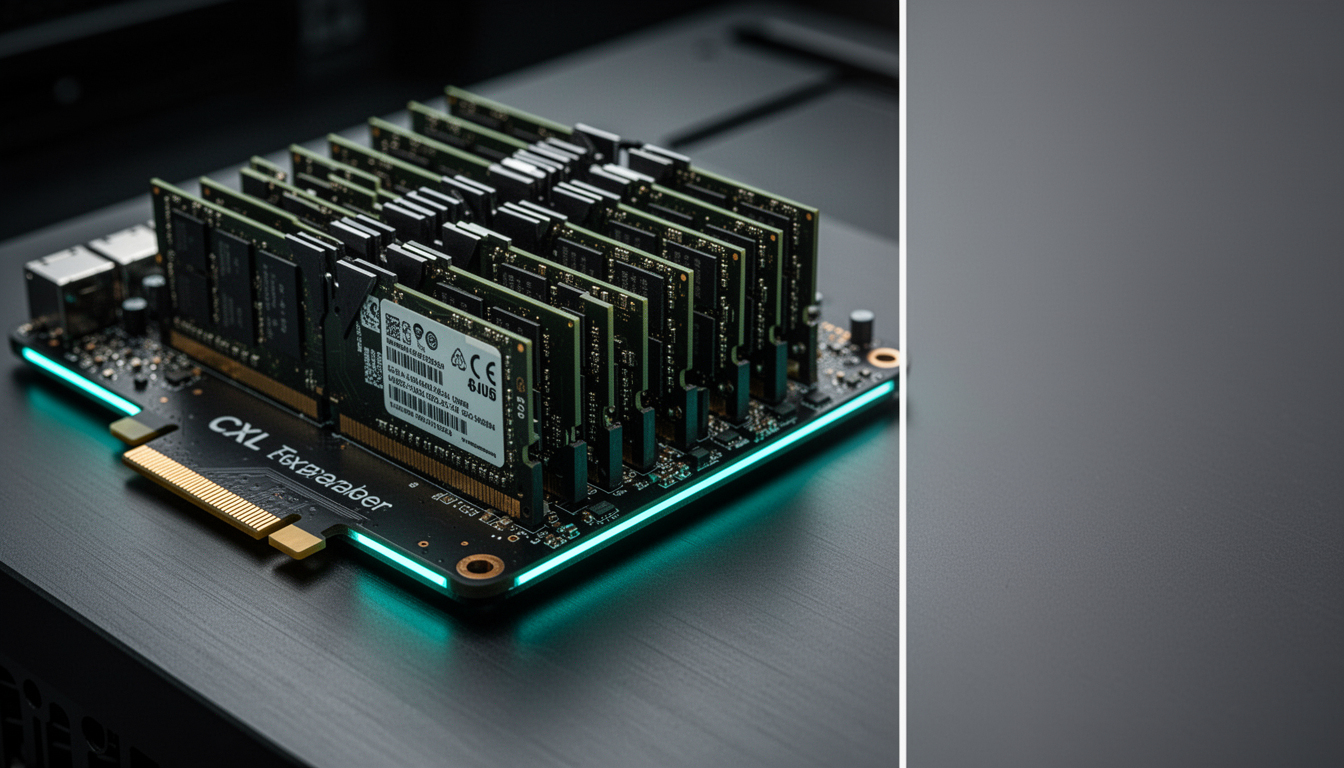
The mechanism is worth understanding because it removes the usual objection to reuse — that old memory is stranded by the hardware it shipped with. Meta developed an in-house CXL controller ASIC, internally called Vistara, that decouples the memory controller from the DIMMs themselves. That decoupling is the key move: it lets retired DDR4 attach to current-generation servers over CXL without the vendor-specific pairing that normally locks a module to its original platform.
On top of the hardware, a software scheduler Meta calls Transparent Page Placement (TPP) decides, per workload, how much of an application's memory should live in fast local DIMMs versus the CXL-attached pool — and can pull expanded memory out of the path entirely for latency-sensitive jobs. The result is near-zero-cost capacity expansion drawn from hardware the company already owns.
Why This Only Works Because the Silicon Still Has Value
CXL-attached memory is not free performance. Meta's own framing acknowledges the tradeoff: expanded memory runs at roughly one-tenth the bandwidth and about 60% higher latency than memory sitting directly on the processor socket. That is why the target workloads are capacity-bound and latency-tolerant — disaggregated ML inference and distributed caching — rather than anything on the hot path.
The important point for the secondary market is what that tradeoff implies. Meta is willing to accept a real performance penalty to keep old DDR4 in service, which only makes sense if the alternative — buying equivalent new capacity — is expensive enough to justify it. In other words, the reuse case is strongest exactly when new supply is tight and pricey. That is the environment the market is in right now, and it is the environment DRAM Resource tracks in real time through the DRAM Market Pulse tool.
The "RAM Tax" and the Case for Reuse
The macro backdrop is familiar: new DRAM pricing has climbed and lead times have stretched, a burden industry observers have started calling the "RAM tax." Meta's answer is not to pay it — at least not for every workload. By turning its installed base of DDR4 into a supply source, the company converts a shortage problem into an inventory problem it can solve internally.
That is the aftermarket thesis stated in hyperscaler terms. When new supply tightens, the value of already-manufactured, already-deployed memory rises, and the spread between what retired modules can be bought or redeployed for and what new capacity costs becomes the number that matters. Buyers who can read that spread — and act on it — hold a structural advantage over those who reflexively buy new or reflexively scrap old.
What It Means for Corporate Buyers and ITAD Programs
Most organizations will never build a custom CXL ASIC. But the underlying economics scale down cleanly. The lesson is not "run CXL"; it is "stop pricing your retired memory as waste." A refresh cycle that treats decommissioned DDR4 as a recoverable asset — redeployed internally where it fits, or remarketed into a secondary channel where it does not — captures value that disposal-first programs leave on the table.
Two practical implications follow. First, disposition timing matters more in a tight market: retired memory clears at stronger prices when new supply is constrained, so the calendar around a refresh is a pricing decision, not just a logistics one. Second, chain-of-custody and grading discipline become the difference between "scrap" and "supply" — the modules Meta is redeploying are trusted because their provenance and condition are known.
Meta's engineering is novel. The economic conclusion underneath it is not. Retired DDR4 still has a job, and in a constrained market, that job is worth more than it has been in years.
Questions or comments? We'd love to hear from you — reach the editorial team at info@dramresource.com.