ITAD Operators Are the New Memory Suppliers — Inside the Aftermarket Flow
By DRAM Resource Editorial Staff
Enterprise server decommissioning cycles are now one of the most important inputs to secondary DRAM supply. As hyperscaler refresh programs and corporate fleet retirements accelerate, ITAD operators processing these assets have effectively become primary market suppliers — pulling, testing, and remarketing server memory at volumes that meaningfully influence spot-market availability. Understanding this flow is no longer optional for corporate buyers and memory traders; it is central to supply intelligence.
The Supply Side Has Shifted
OEM DRAM production remains dominated by a small number of fabs operating on multi-year capacity investment cycles. When enterprise demand spikes — as it has through AI infrastructure buildout — new fab output cannot respond quickly. Allocation constraints cascade: hyperscalers get priority, ODMs receive contracted volumes, and open-market availability tightens.
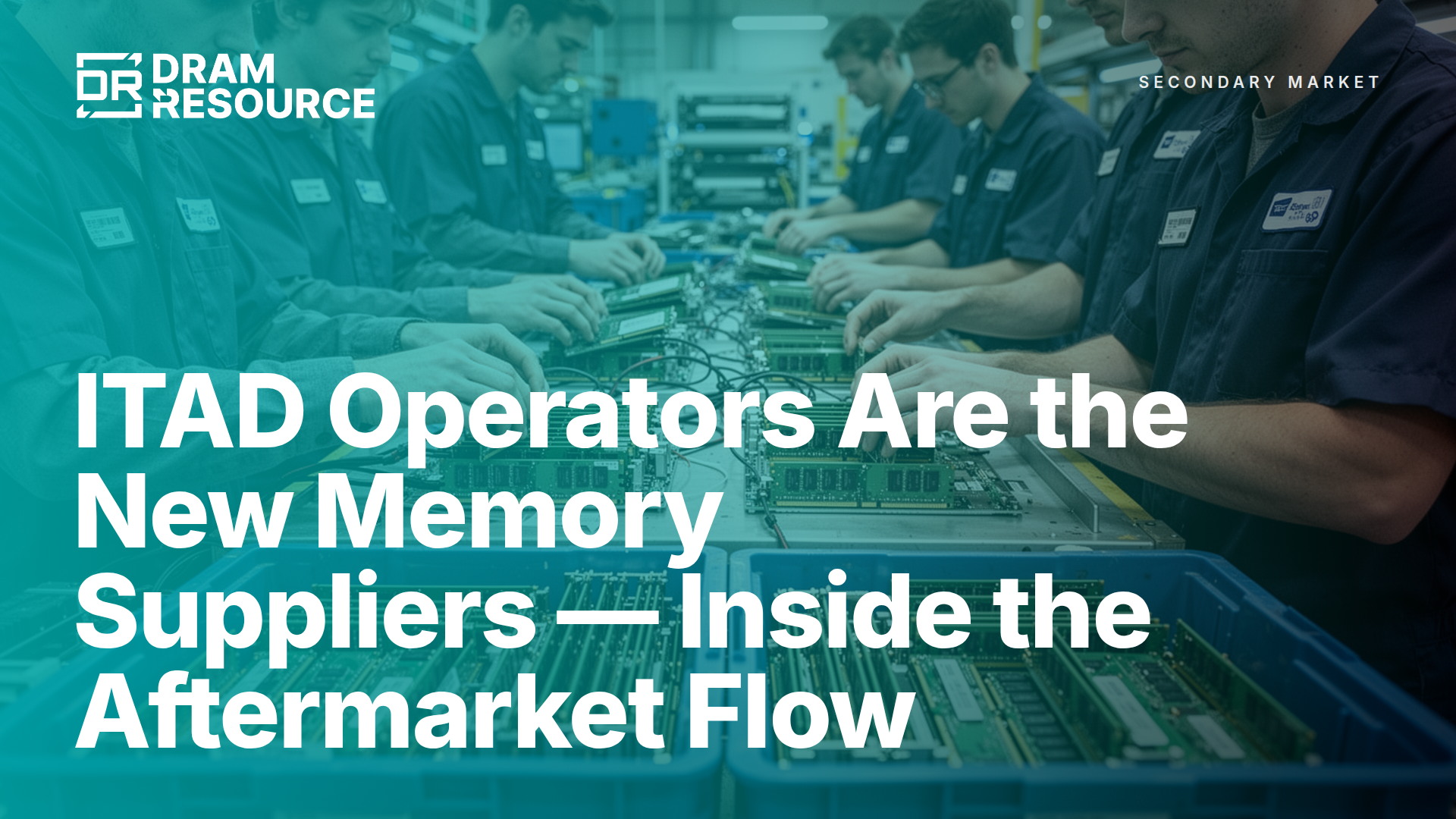
The secondary market has absorbed that gap. ITAD operators processing Tier-1 corporate decommissions are now pulling DDR4 and DDR5 ECC server modules in quantity. When a single enterprise fleet retirement yields tens of thousands of DIMMs — tested, graded, and remarketed within 60–90 days of teardown — those modules enter a channel that competes directly with new supply on both price and availability. Tracking that volume is now essential market intelligence. The DRAM Pulse Report indexes secondary-channel supply flow alongside new production signals.
The Aftermarket Flow: Decommission to Redeployment
The path from a decommissioned server rack to a redeployed DIMM runs through four distinct stages, each with its own timing and value dynamics:
- Teardown and collection. Fleet retirements — typically on 3–5 year refresh cycles for Tier-1 enterprise — generate bulk DIMM inventory. Module condition correlates strongly with workload type and facility cooling environment.
- Testing and grading. Responsible ITAD operators run modules through automated test platforms (memtest, server-slot verification). Grade determines channel: A-grade to resellers and corporate buyers; B-grade to downstream brokers.
- Remarketing. Graded inventory flows into spot brokers, direct resellers, or secondary-market platforms. Pricing is set against new-market spot, typically at a 25–40% discount — though that spread compresses when new supply tightens.
- Redeployment. Corporate buyers — often IT departments managing budget-constrained expansion — absorb this supply as a direct new-supply alternative, particularly for non-AI workloads where DDR4 ECC remains the dominant specification.
The DRAM Market Pulse tool tracks secondary-channel pricing against new-supply benchmarks in real time.
New Supply Remains Structurally Constrained
Fab capacity additions for DRAM are multi-year capital commitments. The current cycle — driven by HBM demand from AI accelerator manufacturers — has further tightened conventional server DRAM allocation. DDR5 transition costs and yield ramp timelines mean OEM output for DDR4 ECC is contracting even as refresh-cycle secondary supply grows. The spread between new-supply allocation pricing and spot secondary pricing is a key forward indicator. Current spread analysis is tracked in Industry Analysis.
The Real Risk Is Undervaluation
Corporate buyers and ITAD operators face the same structural exposure from the secondary market: DRAM is routinely processed and liquidated at bulk commodity rates that do not reflect current market signal. The spread between bulk ITAD teardown rates and actual market value for A-grade server DIMMs can exceed 40% at peak cycle. That is not a compliance gap — it is a valuation gap. For an enterprise retiring a 10,000-node fleet, that spread is material.
Operators who understand where DRAM pricing is moving before they price outgoing inventory capture that margin. Those who price at stale bulk rates transfer it to the buyer. Secondary-market pricing benchmarks and aftermarket flow developments are covered in Industry News.
References
- DRAM Market Research and Pricing Intelligence — https://www.trendforce.com/research/dram.html
- R2 Responsible Recycling Standard for Electronics — https://sustainableelectronics.org/r2-standard
- IDC Worldwide Server Market Tracker — https://www.idc.com/tracker/showproductinfo.jsp?prod_id=37
Questions or comments? We'd love to hear from you — reach the editorial team at info@dramresource.com.