AI Data-Center Buildout Keeps Routing New Memory Away From IT — Aftermarket Fills In
By DRAM Resource Editorial Staff
New DRAM Supply Is Being Claimed Upstream
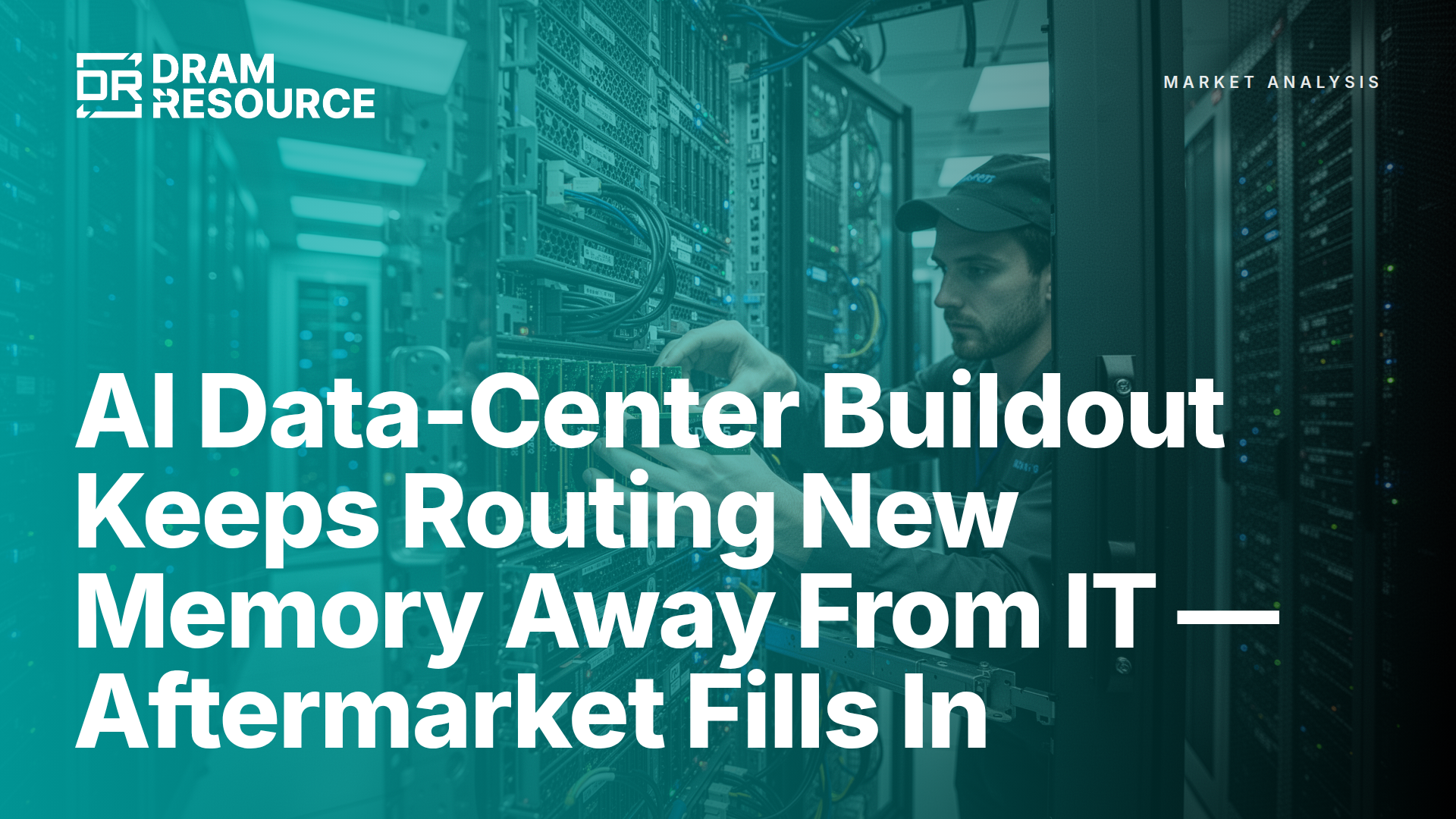
Hyperscale AI infrastructure investment has fundamentally altered DRAM allocation dynamics. The demand profile of a modern AI training cluster — dense HBM on accelerators, plus large pools of RDIMM capacity for orchestration and CPU-attached memory — is absorbing new module production at a rate that leaves conventional enterprise IT procurement at the back of the queue.
DRAM fabrication capacity is not growing proportionally to demand. When a leading hyperscaler contracts a full quarter's RDIMM output from a Tier-1 memory manufacturer, the residual supply available to enterprise distributors tightens sharply. Pricing at the channel tier reflects that constraint.
The Allocation Gap Hits Enterprise IT Hardest
Procurement teams sourcing DDR4 and DDR5 RDIMMs for server refresh cycles are encountering extended lead times and spot-market premiums that were not budgeted at the start of fiscal planning cycles. Organizations with two- to three-year hardware refresh horizons cannot adjust their server orders in real time; the memory requirement is fixed by the platform spec.
The shortfall is not uniform. Organizations running large installed bases of older-generation platforms — those still on DDR4 or even DDR3 ECC — face an additional constraint: new fabrication output is concentrated in DDR5, and the older-gen modules they actually need are no longer in production ramp. What available supply exists lives in the secondary market.
The Aftermarket Channel Is Absorbing Demand
This is the structural dynamic the secondary memory market is built to serve. When primary supply is diverted upstream, the secondary channel — drawing from ITAD pipeline, server decommissions, and tested-pulls from end-of-life enterprise gear — becomes the default source for enterprise memory procurement.
DRAM Market Pulse data shows the spread between secondary-channel pricing and new-module spot has compressed in high-demand SKUs, a reliable indicator that enterprise buyers are routing to the aftermarket as a primary source, not a backup. When the spread narrows, it means secondary supply is being absorbed faster than decommission pipeline can replenish it.
For ITAD operators and resellers holding tested inventory, the signal is straightforward: current market conditions favor realizing value now rather than holding for commodity bulk pricing. The spread between bulk recycling rates and per-module secondary-market pricing has widened significantly in RDIMM categories aligned with current AI-infrastructure platforms, because those same SKUs are in short supply through primary channels.
What This Means for ITAD and Surplus Holders
The DRAM Pulse Report documents the SKU-level divergence: modules that were commodity-grade eighteen months ago are commanding a premium today because they are the residual inventory for enterprise buyers who cannot wait on primary allocation.
ITAD operators processing server decommissions should not accept bulk memory rates that do not reflect current market signal. The correct valuation framework is SKU-level pricing against the secondary market, not a flat per-pound or per-unit commodity rate. The value at risk is the spread between those two numbers, and in the current allocation environment, that spread is material.
For procurement teams, the implication is complementary: qualifying secondary-market vendors with tested, graded inventory provides the supply flexibility that primary channel contracts no longer reliably deliver. Track current secondary-market pricing through Industry Analysis and Industry News coverage to benchmark vendor quotes against live market conditions.
The Structural Shift Is Not Temporary
AI infrastructure buildout is a multi-year capital investment cycle, not a one-quarter pull-forward. Memory fabricators are responding to hyperscaler demand signals with long-horizon capacity commitments. Enterprise IT will continue to compete for DRAM allocation against buyers with larger contracts and faster payment terms.
The secondary market is the durable answer to that structural imbalance. The channel's role is not peripheral — it is filling a primary supply gap at scale. Operators and procurement teams who understand current market pricing are positioned to capture or preserve material value. Those benchmarking against stale commodity rates are not.
References
- IDC Worldwide Memory Market Forecast — https://www.idc.com/getdoc.jsp?containerId=US51974524
- Gartner Market Databook: Server Memory and Storage, Q2 2026 — https://www.gartner.com/en/documents/server-memory-q2-2026
- JEDEC DRAM Technology Roadmap — https://www.jedec.org/standards-documents/focus/flash/dram-technology
Questions or comments? We'd love to hear from you — reach the editorial team at info@dramresource.com.